TLDR
Political yard signs can help a campaign build visibility, name recognition and social proof, especially in local races.
But yard signs should not replace voter contact. They work best when they are part of a broader campaign plan that includes canvassing, phone calls, events, mail, digital outreach and volunteer follow-up.
The smart approach is simple: design signs for fast readability, place them legally, track supporter locations and avoid turning the campaign into a sign-counting contest.
Why Political Yard Signs Still Matter
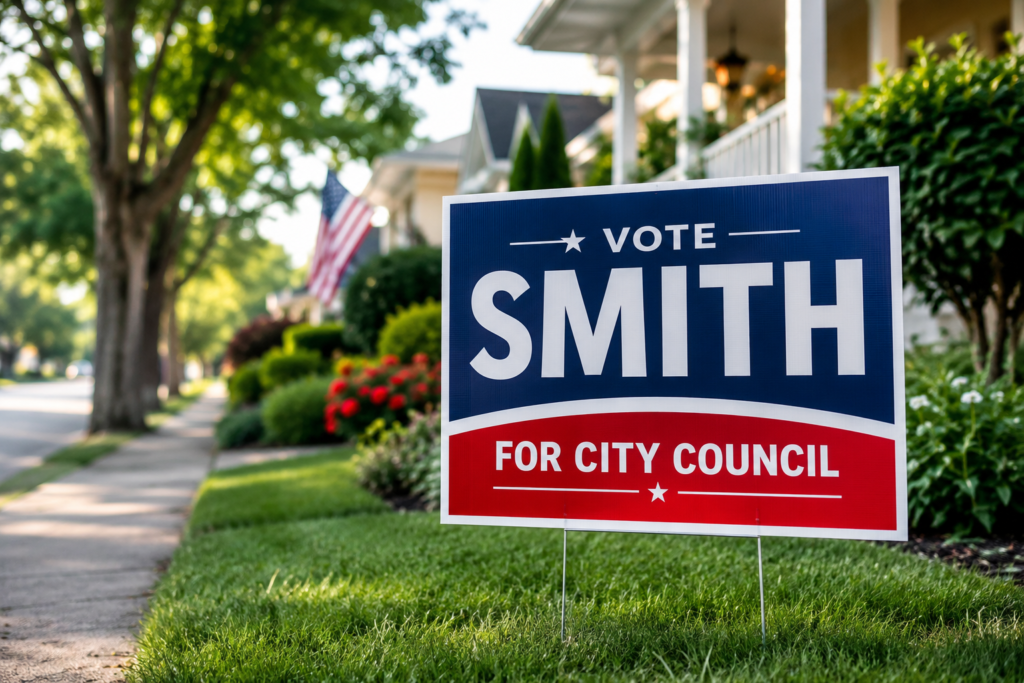
Political yard signs are one of the most familiar parts of campaign season. They pop up on lawns, street corners, farm fences, storefront windows and busy neighborhood roads. Some voters barely notice them. Others treat them like a public scoreboard.
The truth sits somewhere in the middle.
Political yard signs are not magic. They do not knock doors, answer voter questions or explain a candidate’s full platform. A sign cannot replace a real conversation with a voter.
But signs can do something useful: they make a campaign visible. That matters in local elections, where name recognition is often low and voters may be choosing between candidates they have never met. A well-placed sign says, “This person is running, people in this community know them and this campaign is active.”
That is not everything. But it is not nothing.
What Political Yard Signs Are Good At
Political yard signs are best at awareness.
They help voters remember a name. They can reinforce a candidate’s visual identity. They can show neighborhood support. They can also make volunteers, donors and supporters feel like they are part of something visible.
In a local campaign, that has value. A school board, township, city council, county row office or judicial candidate may not have the budget for constant advertising. Yard signs give the campaign a physical presence.
They are especially useful when:
- the candidate has low name recognition
- the race is local or down-ballot
- supporters are concentrated in visible neighborhoods
- the sign design is easy to read from a moving car
- the campaign tracks where signs go
- signs support a broader field plan
The last point matters most. Yard signs should support the campaign. They should not become the campaign.
What Political Yard Signs Are Bad At
Yard signs are weak at persuasion.
Most voters will not change their mind because they saw a sign. A sign can remind them. It can make a candidate look active. It can signal that a neighbor supports someone. But it will not explain healthcare policy, tax priorities, education funding, public safety plans or why the candidate is qualified.
That means campaigns should be careful not to over-invest in signs at the expense of direct voter contact.
Every hour spent assembling, delivering and replacing signs is an hour not spent calling voters, knocking doors, writing thank-you notes, recruiting volunteers or raising money. That does not mean signs are a waste. It means they need a plan.
One of the easiest campaign traps is the sign war. A candidate sees an opponent’s signs and panics. Then the campaign orders more signs, places more signs and spends the next three weeks arguing about who has more signs.
That may feel productive. Usually, it is not.
Voters matter. Signs support voter contact. They do not replace it.
Keep The Design Simple
A political yard sign has only a few seconds to work.
Most people see it while driving, walking a dog or passing through a neighborhood. They are not stopping to read a paragraph. They are catching a name, office and visual impression.
The best political yard signs usually include:
- the candidate’s name
- the office sought
- a short slogan, if it is truly useful
- strong contrast
- large lettering
- a clean layout
- a website only if it is short and readable
The candidate’s name should be the most readable part of the sign. Not the slogan. Not a small seal. Not a complicated logo.
A good rule: if someone cannot read the name from across the street, the design is probably too busy.
Avoid small text, long slogans, low-contrast colors, too many fonts and photos that do not reproduce well. A candidate headshot may work on a mailer or website, but many yard signs are viewed at distance and in bad lighting. In most cases, simple type beats a photo.
Choose Colors That People Can Actually Read
Campaign colors do not need to be boring, but they do need to work.
High contrast matters more than personal taste. Dark text on a light background or light text on a dark background is usually easier to read than two colors with similar brightness.
Blue and white, red and white, black and yellow, navy and yellow or green and white can all work depending on the campaign brand. The exact palette matters less than legibility.
Be careful with yellow text, thin lettering, pale backgrounds and color combinations that look fine on a screen but disappear from the road. Digital mockups can fool you. A sign has to work outdoors, at speed, in rain, at dusk and from imperfect angles.
That is why campaigns should print a proof or sample when possible. Seeing the sign at real size can prevent expensive mistakes.
Pick The Right Size
Most standard political yard signs are designed for quick roadside visibility. Common sizes include 18 x 24 inches and 24 x 18 inches, though larger signs may be used in high-traffic areas, farms, large lots or commercial properties where allowed.
The best size depends on the use.
For residential yards, a standard yard sign is usually enough. For large open spaces or busy roads, a larger sign may make sense. For windows, doors or campaign offices, smaller posters may work better.
Do not assume bigger is always better. Larger signs cost more, take more space, may face stricter local rules and can be harder for volunteers to transport and place.
A smart campaign often uses a mix:
- standard yard signs for supporters
- larger signs for high-visibility private property
- window signs for businesses and apartments where allowed
- event signs for rallies, offices and staging locations
This gives the campaign flexibility without overspending.
Place Signs Legally
This is where campaigns need to slow down.
Political signs are a form of speech, especially on private property, but that does not mean campaigns can place signs anywhere. Rules vary by state, county, municipality and property type.
In Pennsylvania, PennDOT guidance says unauthorized political signs cannot be placed within PennDOT right-of-way along state roads, interstates, expressways and other limited-access highways. The guidance also says political signs cannot be attached to light or signal posts, guide rails or other PennDOT traffic control devices.
That is the kind of rule campaigns need to take seriously.
A sign placed illegally may be removed. It may also create friction with local officials, property owners or voters. No campaign needs that distraction.
The safest approach is to place signs only on private property with permission, outside highway rights-of-way and away from anything that could block sight lines or create a traffic hazard.
Campaigns should also check local ordinances and keep notes on where signs were placed. A simple spreadsheet can save a lot of confusion later.
Use Supporter Yards Strategically
A sign in a supporter’s yard is stronger than a random sign in a random place.
Why? Because it shows actual support. It tells neighbors, friends and passersby that someone in the community is willing to publicly stand with the candidate.
That is a useful signal.
But it is still worth being strategic. Campaigns should prioritize:
- homes on visible streets
- supporters near polling places, where allowed
- neighborhoods with persuadable or high-turnout voters
- homes near community centers, schools or local gathering spots
- areas where the candidate needs more name recognition
The campaign should also use sign requests as organizing opportunities.
If someone asks for a yard sign, do not just drop off the sign and leave. Ask whether they want to volunteer. Ask whether they can host a meet-and-greet. Ask whether they know three neighbors who should hear from the campaign. Ask whether they will share an event.
A yard sign request is a supporter raising their hand. Treat it that way.
Track Every Sign
Campaigns waste time when they do not track signs.
At minimum, track:
- supporter name
- address
- phone or email
- sign quantity
- date delivered
- volunteer assigned
- removal status after the election
This does not need to be complicated. A spreadsheet is fine for a small campaign. A campaign CRM or voter contact system is better for larger operations.
Tracking matters for three reasons.
First, it helps volunteers deliver signs efficiently.
Second, it helps the campaign avoid duplicate deliveries and lost inventory.
Third, it helps with removal after the election. A campaign that leaves signs up for weeks after voters have moved on looks disorganized. Sign cleanup is not glamorous, but it is part of being a responsible campaign.
Do Not Let Signs Eat The Field Program
A campaign can lose a lot of time to signs.
Someone has to order them, pick them up, store them, assemble them, deliver them, replace them, move them and remove them. That work adds up fast.
Before ordering, campaigns should ask:
- How many signs do we actually need?
- Who will deliver them?
- Where will they be stored?
- What is the legal placement plan?
- How will sign requests be tracked?
- Who removes them after Election Day?
- What voter contact work are we not doing if volunteers spend time on signs?
That last question is the uncomfortable one.
A sign program should not drain the energy from canvassing, phone banking, fundraising or voter registration. If the campaign has too few volunteers, signs should be handled in a tight, efficient way rather than becoming the main activity.
Use Signs Near Election Day With Intention
Signs can be especially useful near the end of a campaign, when voter attention rises.
A late sign push can create momentum, remind supporters to vote and make the campaign feel present in the community. But again, it needs to be coordinated.
Think about signs in phases:
Early Campaign: Use signs selectively for launch events, strong supporters and high-visibility homes.
Middle Campaign: Add signs in priority neighborhoods and use sign requests to identify volunteers and hosts.
Final Weeks: Increase visibility, especially with supporters who are also likely to talk to neighbors.
Election Day: Use signs where legally allowed to help voters identify campaign presence near polling areas.
Do not wait until the last week to think about logistics. Stakes, storage, delivery lists and volunteer assignments should be ready before the final rush.
Political Yard Signs And Social Proof
One reason political yard signs still matter is social proof.
People notice what their neighbors support. That does not mean they blindly follow it, but local visibility can create a sense that a candidate is credible, active and known.
This is especially true in small races where voters may have little information. If a school board candidate has signs in yards across several neighborhoods, voters may assume that candidate has real community support. That can help the candidate get a closer look.
Still, campaigns should be careful. Social proof only works when it feels real. A cluster of signs in actual supporter yards is usually more meaningful than a row of signs dumped in a public strip where they may not belong.
A campaign should look supported, not spammy.
Common Yard Sign Mistakes
The same mistakes show up in campaign after campaign.
The sign is too crowded.
The candidate’s name is too small.
The office is unclear.
The colors are hard to read.
The signs are ordered too late.
No one tracks deliveries.
Volunteers spend too much time on signs.
Signs are placed where they are not allowed.
The campaign forgets to remove them after the election.
Most of these are avoidable.
A good political yard sign program is not complicated. It just needs discipline. Design clearly. Order early. Place legally. Track everything. Use signs to activate supporters, not distract from voters.
Best Recommendation
Political yard signs are worth using, but they should have a defined role.
They are good for visibility, name recognition and supporter energy. They are not a replacement for a real field plan. The strongest campaigns use signs as one tool inside a larger strategy that includes voter contact, clear messaging, fundraising, events and follow-up.
If the campaign is spending more time talking about signs than voters, something has gone off track.
A smart sign program should feel organized, legal and easy to manage. The signs should be readable. The placement should be intentional. The supporter list should be tracked. And when Election Day is over, the campaign should clean them up quickly.
That is how political yard signs help a campaign instead of taking it over.
FAQs
Do Political Yard Signs Actually Work?
Political yard signs can help with name recognition and visibility. Research suggests they may have a modest effect on vote share, but they are not a substitute for direct voter contact.
What Should A Political Yard Sign Say?
A political yard sign should usually include the candidate’s name, the office sought and possibly a short slogan. The name should be the easiest part to read.
What Size Should A Campaign Yard Sign Be?
A common size is 18 x 24 inches, but larger signs may be useful for high-visibility private property. Campaigns should check local rules before ordering large signs.
Can Political Signs Be Placed On Public Property?
Rules vary, but campaigns should be careful. In Pennsylvania, PennDOT guidance says unauthorized political signs cannot be placed within PennDOT right-of-way along state roads, interstates, expressways and other limited-access highways.
How Many Yard Signs Should A Campaign Order?
It depends on the race, district size, budget and volunteer capacity. Campaigns should avoid ordering more signs than they can legally place, track, deliver and remove.
When Should Political Yard Signs Be Removed?
Campaigns should remove signs promptly after the election and follow state or local rules. Even when rules are unclear, quick cleanup shows professionalism and respect for the community.